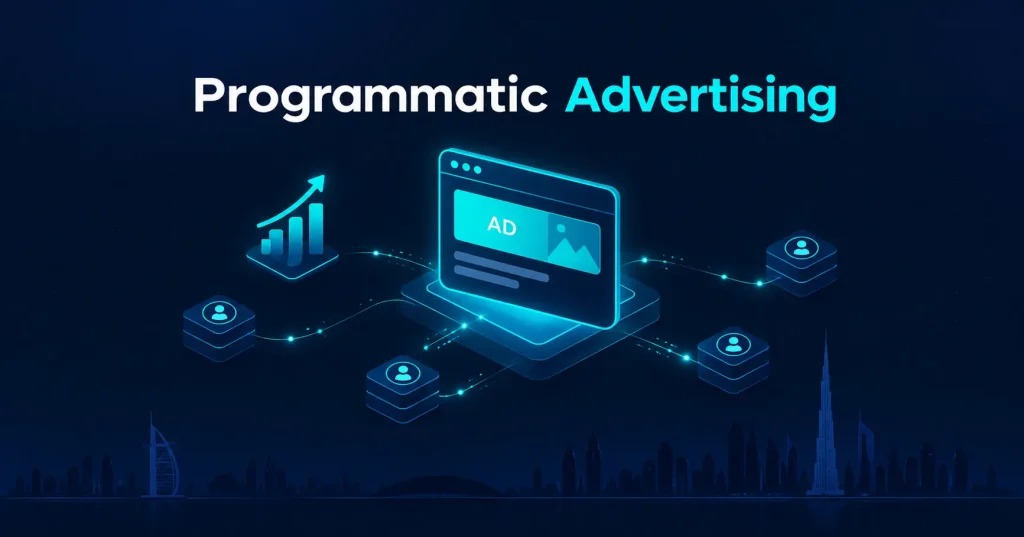


Programmatic advertising is the automated buying and placement of digital ads using real-time bidding (RTB) technology. In the UAE, it lets businesses target specific audiences by location, device, language, or behavior across thousands of websites and apps simultaneously, with pricing set instantly through algorithmic auctions rather than manual negotiation.
If you’ve managed a Google or Meta ad account in Dubai or Abu Dhabi, you’ve already touched programmatic advertising without necessarily calling it that. But real programmatic buying automated, data-driven ad purchasing across thousands of websites, apps, and streaming platforms in a single bid is a different animal from boosting a post or running a search campaign. For UAE businesses competing in a market where ad inventory is fragmented across Arabic and English audiences, expat and local segments, and mobile-first users, programmatic offers a way to reach the right person at the right moment without manually managing dozens of placements. This guide breaks down exactly what programmatic advertising is, how it works, and whether it’s worth the investment for your business.
What Programmatic Advertising Actually Means
Programmatic advertising replaces the traditional process of a media buyer calling up a publisher, negotiating a rate, and manually placing an ad. Instead, software does the buying. A Demand-Side Platform (DSP) tools like Google Display & Video 360, The Trade Desk, or Amazon DSP connects to ad exchanges where publishers sell inventory in real time. When a user in Dubai Marina opens a news app, an auction happens in the background, in under 100 milliseconds, and the highest relevant bidder’s ad appears. This is real-time bidding (RTB), and it’s the engine behind programmatic.
For a UAE retailer running a Ramadan promotion, this means an ad can automatically show to an Arabic-speaking user browsing a recipe site at 4pm and a different creative to an expat professional reading business news at 9am all without a human choosing each placement.
How Programmatic Buying Works, Step by Step
The mechanics involve a handful of connected systems working together in milliseconds:
- Ad exchange: The marketplace where publisher inventory (website and app ad space) is listed for auction.
- Supply-Side Platform (SSP): Used by publishers think Gulf News, Khaleej Times, or local app networks to sell their ad space programmatically.
- Demand-Side Platform (DSP): Used by advertisers to set targeting rules, budgets, and bids, then automatically buy inventory that matches.
- Data Management Platform (DMP): Aggregates audience data demographics, interests, past behavior so the DSP knows who’s worth bidding on.
- Real-time bidding: The auction itself, where the winning bid is decided and the ad is served, typically before the webpage finishes loading.
For a company in Business Bay running a lead-generation campaign, the DSP might be set to bid higher for UAE-based users aged 25-45 who’ve recently searched for property listings, and lower or not at all for traffic outside the target market.
Why Programmatic Matters for UAE Businesses
The UAE’s digital ad market is unusual: high smartphone penetration (over 95%), a bilingual audience split between Arabic and English content consumption, and a population where roughly 90% are expatriates from dozens of countries. That fragmentation is exactly the problem programmatic solves. Rather than buying a blanket display package on one Arabic news site and hoping the right people see it, a Sharjah-based logistics company can programmatically target decision-makers by job title, company size, and browsing behavior across hundreds of B2B and industry sites at once.
Cost efficiency is another driver. Programmatic auctions mean businesses generally pay only for the audience segments that match their criteria, rather than a flat rate for a placement regardless of who sees it. Combined with granular reporting, this makes it easier to prove ROI to stakeholders a recurring challenge for marketing teams across the region.
Common Programmatic Ad Formats in the UAE Market
Programmatic isn’t limited to banner ads. UAE advertisers commonly use it across several formats:
- Display ads: Standard banner placements across news sites, blogs, and content networks.
- Video (pre-roll and in-stream): Ads served before or during video content on platforms like YouTube or connected TV apps popular with UAE households.
- Native advertising: Ads styled to match the look of the publisher’s content, common on Arabic news portals.
- Digital out-of-home (DOOH): Programmatic buying now extends to digital billboards along Sheikh Zayed Road and in malls like Dubai Mall, where ad content can change based on time of day or even weather.
- Audio: Programmatic buys on streaming platforms like Spotify and Anghami, both widely used across the UAE.
Common Pitfalls UAE Advertisers Run Into
Programmatic’s automation is also where most costly mistakes happen, usually because campaigns are set up once and left to run without ongoing oversight. The most frequent issues seen in the UAE market include:
- Ad fraud and bot traffic: Without proper verification tools (like IAS or DoubleVerify), a portion of programmatic spend can go toward impressions served to bots rather than real users.
- Poor geo-targeting hygiene: Campaigns aimed at ‘UAE’ without excluding VPN traffic or neighboring countries can waste budget on unqualified impressions.
- Overlapping audiences across platforms: Running the same retargeting list on multiple DSPs simultaneously can inflate frequency and annoy users rather than convert them.
- Ignoring viewability: A cheap impression that’s never actually seen on screen (below the fold, in a background tab) delivers no value regardless of the price paid for it.
Businesses that review placement reports weekly and maintain updated exclusion lists consistently see better performance than those who treat programmatic as a set-it-and-forget-it channel.
Getting Started: What UAE Businesses Should Know Before Investing
Programmatic works best with sufficient budget and a clear first-party data strategy retargeting website visitors or CRM lists tends to outperform pure cold targeting. Businesses new to programmatic typically start with a DSP that has strong regional inventory coverage in the GCC, set a testing budget (often AED 10,000-20,000/month minimum to gather meaningful data), and run for at least 4-6 weeks before optimizing based on results. It also pays to be aware of brand safety settings, since automated buying across thousands of sites can occasionally place ads next to undesirable content without proper exclusion lists.
Working with a partner who understands both the technology and the local market language nuances, cultural sensitivities during periods like Ramadan, and which publishers actually reach your audience tends to produce far better results than running programmatic in-house without regional expertise.
Frequently Asked Questions
Q:1 Is programmatic advertising the same as Google Ads?
A: No. Google Ads is one specific platform, largely used for search and its own display network. Programmatic advertising is broader it refers to the automated buying method itself, which can happen through many DSPs (including Google’s Display & Video 360) across a much wider range of publishers and formats.
Q:2 How much does programmatic advertising cost in the UAE?
A: Costs vary by format and competition, but most UAE campaigns start with monthly budgets between AED 10,000 and AED 50,000 to generate enough auction data for the algorithm to optimize effectively. Smaller budgets can work but typically take longer to show strong results.
Q:3 Can programmatic ads target Arabic-speaking audiences specifically?
A: Yes. DSPs allow targeting by language preference, site content language, and geographic sub-regions, making it possible to run separate creative and messaging for Arabic and English-speaking segments within the same campaign.
Q:4 Is programmatic advertising suitable for small businesses in the UAE?
A: It can be, particularly for retargeting website visitors, but small businesses with limited budgets often see better initial ROI from search and social ads before adding programmatic display or video once they have first-party data to work with.
Q:5 What’s the difference between programmatic and real-time bidding (RTB)?
A: RTB is the auction mechanism the specific process of bidding for an impression in real time. Programmatic is the umbrella term for the entire automated buying ecosystem, of which RTB is one (very common) method; some programmatic deals are negotiated in advance at a fixed price without a live auction.
Q:6 How is programmatic performance measured?
A: Standard metrics include impressions, click-through rate (CTR), viewability, cost per acquisition (CPA), and conversion rate, tracked through the DSP’s dashboard and typically cross-referenced with Google Analytics or a CRM to measure actual business impact, not just clicks.
Ready to Explore Programmatic for Your Business?
Programmatic advertising can dramatically improve targeting precision and budget efficiency for UAE businesses, but getting the setup, audience data, and platform selection right makes the difference between wasted spend and measurable ROI.
C Zone Star helps UAE businesses plan and manage programmatic campaigns that reach the right audience without the guesswork. Book a free consultation at Czone Star to see if programmatic is the right fit for your marketing goals.