


















Picking a web development partner is one of those decisions that looks simple until you are halfway into it. Every company you call promises the same things: fast, secure, scalable, modern. The words blur together, the quotes vary wildly, and you are left trying to judge something technical with no technical background. If you are a business owner in the weighing up UAE web development services and trying to spend your budget wisely, the goal of this guide is to give you a clear way to think about the choice, not another sales pitch dressed up as advice.
Let me start by clearing up the thing that trips up most people before they even begin.
Web Design and Web Development
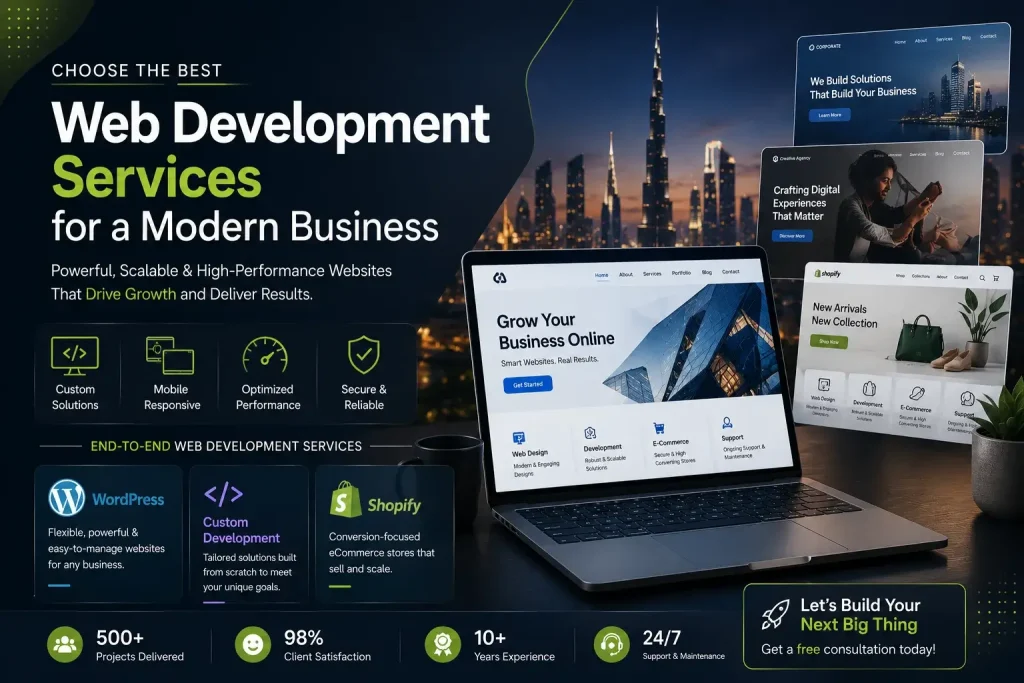
These two terms get used as if they mean the same thing, and that confusion costs businesses real money. Web design is about how a site looks and feels: the layout, the colours, the flow a visitor moves through. Web development is about what the site can actually do: the functionality underneath, the way it handles data, the speed, the security, and how well it holds up as your business grows.
A simple brochure site needs mostly design. Booking platform, a customer portal, an online store with inventory, or any tool your team or clients log into needs real development. When a business hires a designer for a job that needed a developer, they end up with something that looks good and breaks under pressure. Knowing which one you actually need is the first money-saving decision you will make.
What “Modern” Web Development Actually Means
The word modern gets thrown around loosely, so here is what it should mean in practice when you pay for web development services in UAE. Strip away the marketing and a well-built modern web project comes down to four things that genuinely matter.
The first is performance. A site or application has to load quickly and stay quick as more people use it. Speed is not a vanity metric. It affects how long visitors stay, how Google ranks you, and whether a frustrated user gives up before they convert. Good development gets this right through clean code and sensible architecture, not by bolting on plugins after the fact.
The second is scalability. The platform should handle ten customers and ten thousand without needing to be rebuilt from scratch. A lot of cheap builds work fine on launch day and then buckle the moment the business grows, which is the worst possible time for your technology to fail you. Building for scale early is far cheaper than rescuing a system later.
The third is security. Any site that collects enquiries, takes payments, or stores customer information is holding something worth protecting. Proper development bakes in secure data handling, safe payment processing, and protection against the common attacks, rather than treating security as an afterthought once something goes wrong.
The fourth is integration. Modern businesses rarely run on one tool. You might need the website to talk to your CRM, your accounting software, a payment gateway, a delivery service, or a WhatsApp channel. A capable development team builds these connections so your systems work together instead of forcing your staff to copy data between them by hand.
If a company cannot explain how they handle these four areas in plain language, that tells you something useful before you have spent a dirham.
The Template Trap, and When Custom Is Worth It
There is nothing wrong with a template website. For a small business that needs a clean, professional presence and nothing more, a well-set-up template can be the smart, affordable choice, and anyone who tells you otherwise is usually trying to oversell.
The trap is using a template for something it was never built to do. Templates start to fight you the moment you need custom features, unusual workflows, or anything specific to how your business actually operates. You end up paying developers to force a rigid system to behave in ways it resists, which often costs more than building it properly in the first place.
Custom web development earns its price when your business logic is the product. A car showroom that needs to manage inventory and customer enquiries, a school that runs admissions and fees through its system, a company that needs a private portal for clients, these are not template jobs. They need software built around how the business works. The honest question to ask is not “custom or template,” but “is what I need standard, or is it specific to me.” That answer points you to the right spend.
How to Judge a Web Development Company Before You Hire One
Most businesses choose a developer based on price and a nice portfolio, then regret it later. A better approach is to look for a few signals that are harder to fake.
Ask to see things they have actually built and used, not just designed. Anyone can show pretty mockups. A company that has built and runs real working platforms has solved the hard problems that only show up in live systems. Ask how they handle a project after launch too, because the day you go live is the start of the relationship, not the end of it. Sites need updates, fixes, and support, and a developer who disappears after delivery leaves you stranded.
Pay attention to how they communicate during the sales conversation itself. If they listen, ask about your business before talking about technology, and push back when your idea has a flaw, that is a good sign. The best development partners think with you about the logic of what you are building rather than blindly doing whatever the brief says. Vague answers, pressure to sign quickly, and a refusal to explain things simply are all worth treating as warnings.
What This Looks Like for Businesses Across the UAE
The local context shapes what good web development services means here. A serious chunk of your audience uses both Arabic and English, so a platform that handles bilingual content cleanly reaches a wider market than one that does not. Payment expectations differ too. Customers expect smooth, trusted local payment options, so proper integration with the gateways people actually use in the Emirates matters more than a generic checkout.
There is also the speed of the market. Free-zone startups in Dubai, growing SMEs in Sharjah and Ajman, established firms in Abu Dhabi, all of them are competing in an environment where customers judge a business partly by how polished and capable its technology feels. A web platform that is fast, secure, and clearly built for the region quietly signals that you are a serious operator. A clumsy one signals the opposite, no matter how good your actual service is.
Why Businesses Work With C Zone Star
We have been building websites and web applications for businesses across the UAE since 2015, and the part we are most useful at is the development that sits under the surface, not just the visible design. The clearest proof of that is the software we have built and run ourselves. Our School Management System, Accounts Management System, and Cars Showroom Management System are full working platforms with real users, real data, and real business logic, which is a very different discipline from putting together a marketing page.
That experience changes how we approach a project. We start by understanding how your business actually operates, then build technology around it, with performance, security, and the room to grow treated as part of the plan rather than upgrades you discover you need later. We also stay involved after launch, because a platform that nobody maintains slowly becomes a liability. Clients tend to notice the difference most in the things that do not break and the requests that get handled quickly.
If you are weighing up web development and you are not sure whether you need a simple site or a custom platform, the most useful first step is a straight conversation. Tell us what you are trying to build and what your business needs to do, and we will tell you honestly what that actually requires, including when a simpler and cheaper option would serve you better.
Talk to C Zone Star about your web development project. We will look at what you need, explain your options in plain language, and give you a clear sense of scope and cost before you commit to anything.
Frequently Ask Questions
Q 1: What is the difference between web design and web development?
A: Web design covers how a website looks and feels, including layout, colours, and the flow a visitor moves through. Web development covers what the site can actually do, including its functionality, speed, security, and how it handles data. A simple brochure site is mostly a design job, while a portal, booking system, or online store with real features needs proper development.
Q 2: Do I need a custom website or is a template enough?
A: It depends on whether what you need is standard or specific to your business. If you want a clean, professional presence and nothing unusual, a well-built template is often the smart and affordable choice. If your business runs on specific workflows, such as inventory, bookings, client logins, or custom processes, a template will fight you, and custom development becomes the better long-term value.
Q 3: How much do web development services cost in the UAE?
A: Cost depends almost entirely on complexity. A straightforward business website sits at one end, while a custom web application with integrations, user accounts, and ongoing functionality sits much higher. The honest way to get a real figure is to define exactly what the platform needs to do first, because scope, not page count, is what drives the price.
Q 4: What should I look for when choosing a web development company?
A: Look for a team that has built and maintains real working platforms, not just designed pretty pages, since live systems reveal who can solve hard problems. Ask how they handle support after launch, watch whether they understand your business before talking technology, and treat vague answers or pressure to sign quickly as warning signs.
Q 5: How long does it take to build a website or web application?
A: A standard business website can take a few weeks, while a custom web application can run from a couple of months to longer, depending on features, integrations, and testing. A reliable developer will give you a realistic timeline tied to scope and will not promise a complex platform in an unrealistically short window.
