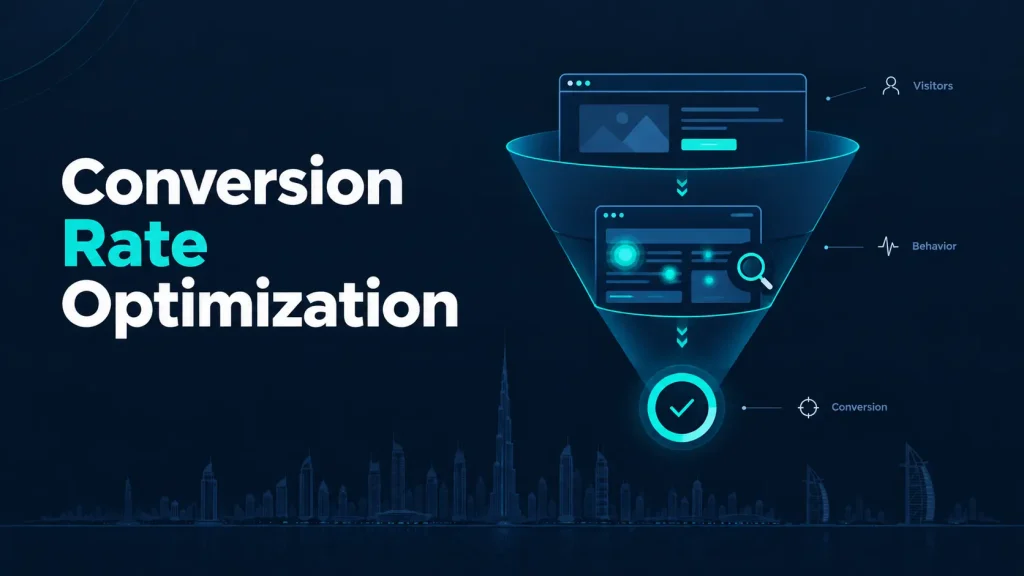



















PPC landing page optimization is the process of improving the page a paid ad sends visitors to. The goal is simple. More of that traffic converts into leads or sales, instead of leaving. It covers message match, page speed, mobile design, and form length. It also covers Google’s Quality Score, which directly affects how much each click costs. Without it, a business pays for clicks that arrive somewhere unconvincing and simply leave.
A home decor brand in JLT was running Google Search ads for “custom furniture Dubai.” They sent every single click to their homepage. Cost per click kept climbing every month, and nobody could explain why. It wasn’t the keywords. It wasn’t the budget. PPC landing page optimization was the missing piece nobody on the team had actually looked at. It’s usually the reason a technically solid campaign quietly bleeds money for months before anyone notices.
Why Does One Landing Page Mistake Wreck an Otherwise Good PPC Campaign?
The JLT furniture brand’s homepage looked fine on its own terms, it just had nothing to do with custom furniture specifically. A slider of five product categories, a newsletter signup, and a company history section stood in the way. None of it answered what the visitor had searched for. This happens constantly in the UAE, a business builds a solid campaign, tight keywords, decent ad copy, reasonable budget, then quietly sabotages it by pointing every click at a generic homepage.
There’s a common myth behind this mistake. Some businesses assume a homepage is somehow safer, more complete, since it “shows everything.” The opposite is usually true. A visitor who clicked a specific ad wants a specific answer, not a menu of everything the business sells. Sending them somewhere broad, when they arrived with a narrow intent, is the single most repeated landing page mistake in this market. It rarely gets caught because the campaign still technically “runs.”
How Does Google’s Quality Score Actually Punish a Bad Landing Page?
Under Google’s Quality Score guidelines, three things determine the score. Expected click-through rate, ad relevance, and landing page experience. That third component is entirely within a business’s control, and it’s the one most commonly ignored. A landing page that matches the ad’s promise, loads fast, and gives the visitor an obvious next step improves landing page experience directly. That lowers cost per click.
A mismatched, slow, or cluttered landing page lowers Quality Score. A lower Quality Score means paying more for the same keyword a competitor is bidding on with a better page. This isn’t a minor ranking factor. It’s a direct line item on the invoice.
In our own Google Search campaign work across the UAE, this is the single most common account-level issue we find during an audit, strong keywords sitting on top of a landing page nobody had reviewed since launch. C Zone Star has managed paid campaigns like this since 2015, as a certified Google Ads Partner and Meta Business Partner, across 500 plus projects across all seven emirates. A landing page review is often the fastest, cheapest fix, and the one businesses check last, not first.
Message Match: The First and Simplest Fix
Message match is the first thing to fix, and it’s the simplest. If the ad says “Custom Furniture Dubai,” the headline should say something close to that. Immediately, above the fold. Not buried under a hero image carousel. Not three scrolls down after a company mission statement. A visitor should understand within a few seconds that they’ve landed somewhere relevant to what they clicked.
A short testimonial or a real client name near the headline does real work here too, it tells a first-time visitor someone else already trusted this business with the same problem they’re trying to solve. It doesn’t need to be elaborate, one line and a name outperforms a wall of five-star icons with no context behind them.
| Landing Page Quality | Landing Page Experience Signal | Typical Business Outcome |
|---|---|---|
| Matches the ad exactly, loads fast, one clear CTA | Above average | Lower cost per click, higher conversion rate |
| Generic homepage, slow load, buried CTA | Below average | Higher cost per click, wasted ad spend |
| Mismatched headline, no obvious next step | Below average | High bounce rate, weaker Quality Score across the account |
This is also where a proper landing page design service in Dubai earns its cost back quickly, a page built with message match and trust signals in mind from the start avoids the retrofit most businesses end up needing later.
Why Does Page Speed Matter More in the UAE Than Almost Anywhere Else?
Page speed matters more here than in most markets, and this is worth sitting with. According to Ookla’s Speedtest Global Index, the UAE has the fastest median mobile internet speed in the world. Well over 600 Mbps. UAE visitors are not waiting on a slow connection. If a landing page takes several seconds to load, that’s not the network’s fault. It’s the page.
What most business owners don’t realize is this. A slow landing page in the UAE looks worse than the same page would in a market with average internet speeds. Visitors here have nothing to blame but the page itself. No buffering wheel to excuse the wait, no patience built from years of slow mobile data. A business in this market genuinely has no excuse for a sluggish landing page, the infrastructure exists to load instantly.
The technical reason behind this is Google doesn’t measure page speed as one number. It breaks landing page experience into distinct signals, one of the most damaging being layout shift, elements jumping around as the page finishes loading, a button shifting just as someone taps it. A page can visually load fast and still score poorly here, because the visitor’s real experience was clicking the wrong thing. That matters more on mobile, where nearly all UAE traffic sits.
Designing for a Mobile-First UAE Audience
Mobile matters just as much as speed. Based on DataReportal’s UAE data, mobile phones generate roughly three-quarters of all web traffic here. Most internet users access the web primarily through a mobile device. Designing a page on a laptop screen, then assuming it works fine on mobile, is a common and costly mistake. Buttons that are easy to tap matter here. Forms that don’t require zooming matter too. So does text you don’t have to pinch and zoom just to read, more here than in a market where desktop still holds a real share.
Think of a landing page like a hotel’s valet stand next to a generic parking lot. Pull up to valet, hand over your keys, and you walk straight into where you’re going. No searching, no second-guessing. Get dumped in a large, unmarked parking lot instead, and you’re left figuring out the way in yourself. Plenty of visitors just leave rather than bother. That valet stand is a dedicated, message-matched landing page. The unmarked lot is a generic homepage.
How Long Should a PPC Landing Page Form Actually Be?
Forms are where a lot of otherwise good landing pages lose conversions. Every additional field past the essentials, name, email, and maybe one qualifying question, reduces completion rates. Chasing high lead volume means keeping forms short. Needing to qualify leads more tightly can justify a longer form. That’s a deliberate tradeoff though, made on purpose, not a default nobody questioned.
Why Do Most UAE Businesses Skip A/B Testing Entirely?
A/B testing closes the loop, and most businesses skip it entirely. Change one element at a time, headline, CTA wording, or form length. Let the data decide, not a gut feeling. Most businesses build a page once, launch it, and leave it alone indefinitely. They never learn which version would have actually performed better with a small, deliberate change.
Which Metrics Actually Tell You Something
Testing means nothing without knowing what to measure. Click-through rate shows how often people click the ad itself, a strong CTR signals the ad copy is working. Conversion rate shows how many of those clicks turn into a lead or sale once they land, this is the number a landing page actually controls. Cost per click and cost per conversion tell you what you’re paying at each stage, and bounce rate flags a page that isn’t holding attention long enough to matter. Return on ad spend ties all of it together into one number, how much revenue came back for every dirham spent. A business tracking only clicks and ignoring conversion rate is measuring the ad, not the landing page, and missing exactly the part it can actually fix.
Is AI Search Changing What a Landing Page Needs to Do?
Search behavior is shifting in ways that touch landing pages too. AI Overviews and generative search tools increasingly summarize what a page is about before a user ever clicks through. A landing page’s headline and opening copy now do double duty. They need to convert a human visitor and read clearly to an AI system scanning the page’s content. This is a pattern worth building around, not a guaranteed ranking mechanic. Pages already writing clear, direct copy for humans are the same ones positioned well for this shift.
Here’s something agencies rarely explain: many landing page builders render the hero headline, the exact text meant to do the message-match work, as an image or a JavaScript overlay rather than plain crawlable text, purely for design flexibility. A human sees it fine. A text-based AI summarization tool scanning the page may miss it entirely. A UAE business chasing AI-era visibility should confirm its value proposition exists as real, selectable text, not just a design layer that looks right but reads as nothing.
Does a UAE Landing Page Ever Need a Government Permit?
For most PPC campaigns, no. But one is easy to miss: any Dubai real estate landing page or microsite promoting a specific project needs a valid Trakheesi permit from the Dubai Land Department, permit number displayed on the page. This covers landing pages specifically, not just portal listings. Fines start around AED 50,000 and rise for repeat violations. A fast, well-optimized page can still get flagged and pulled if this one detail is missed.
How the JLT Furniture Brand Fixed Their Landing Page
The fix was building one dedicated landing page for the “custom furniture Dubai” campaign specifically. Matching the ad headline exactly. Cutting the form down to three fields. Removing the unrelated product carousel entirely. Cost per click dropped within the first month. Not because the bid changed, but because Google’s own Quality Score rewarded a page that finally matched what the ad promised.
This isn’t unique to Google Search campaigns either, the same message match discipline applies whether the traffic is coming from Facebook Ads, TikTok Ads, or any other paid channel feeding into a UAE business’s wider paid marketing strategy. The platform changes. The landing page rules don’t. That strategy sits within the broader digital marketing approach most UAE businesses need across every channel, not just one.
Frequently Asked Questions (FAQ)
Q1: What is PPC landing page optimization?
A: PPC landing page optimization is the process of improving the page a paid ad sends visitors to, so more traffic converts into leads or sales. It covers message match, page speed, mobile design, form length, and Google’s Quality Score, which directly affects how much each click costs.
Q2: How does a landing page affect Google Ads Quality Score?
A: Landing page experience is one of three components in Google’s Quality Score, alongside expected click-through rate and ad relevance. A page that matches the ad’s promise, loads fast, and gives a clear next step improves this score directly, which lowers cost per click across the campaign.
Q3: Why does page speed matter more for PPC landing pages in the UAE?
A: According to Ookla’s Speedtest Global Index, the UAE has the fastest median mobile internet speed in the world. UAE visitors are not waiting on a slow connection, so a slow-loading landing page has no external excuse and looks worse here than in slower markets.
Q4: How long should a PPC landing page form be?
A: Every additional field past the essentials, name, email, and one qualifying question, reduces completion rates. Businesses chasing high lead volume should keep forms short. A longer form can be justified when tighter lead qualification is the actual goal, but it should be a deliberate choice.
Q5: Do UAE real estate landing pages need a Trakheesi permit?
A: Yes. Dubai real estate landing pages and microsites promoting a specific project or unit require a valid Trakheesi permit from the Dubai Land Department, with the permit number displayed on the page. Advertising without one is a RERA violation with fines starting around AED 50,000.
Q6: Can AI search tools read PPC landing pages properly?
A: Only if the key text is real, crawlable content. Some landing page builders render headlines as images or JavaScript overlays for design flexibility, which a human sees clearly but a text-based AI summarization tool may miss entirely when scanning the page for its actual content.
Final Thoughts
PPC landing page optimization isn’t a separate project from a paid campaign, it’s the other half of it. Fix message match first. Take advantage of the UAE’s genuinely fast infrastructure instead of wasting it on a slow page. Keep forms short unless there’s a real reason not to. Check the technical details, layout shift, crawlable text, and any permit requirements specific to the industry, before assuming a fast-looking page is actually doing its job.
Book a free consultation at C Zone Star, or explore how we approach paid marketing across the UAE for businesses like yours.
Written by the SEO team at C Zone Star